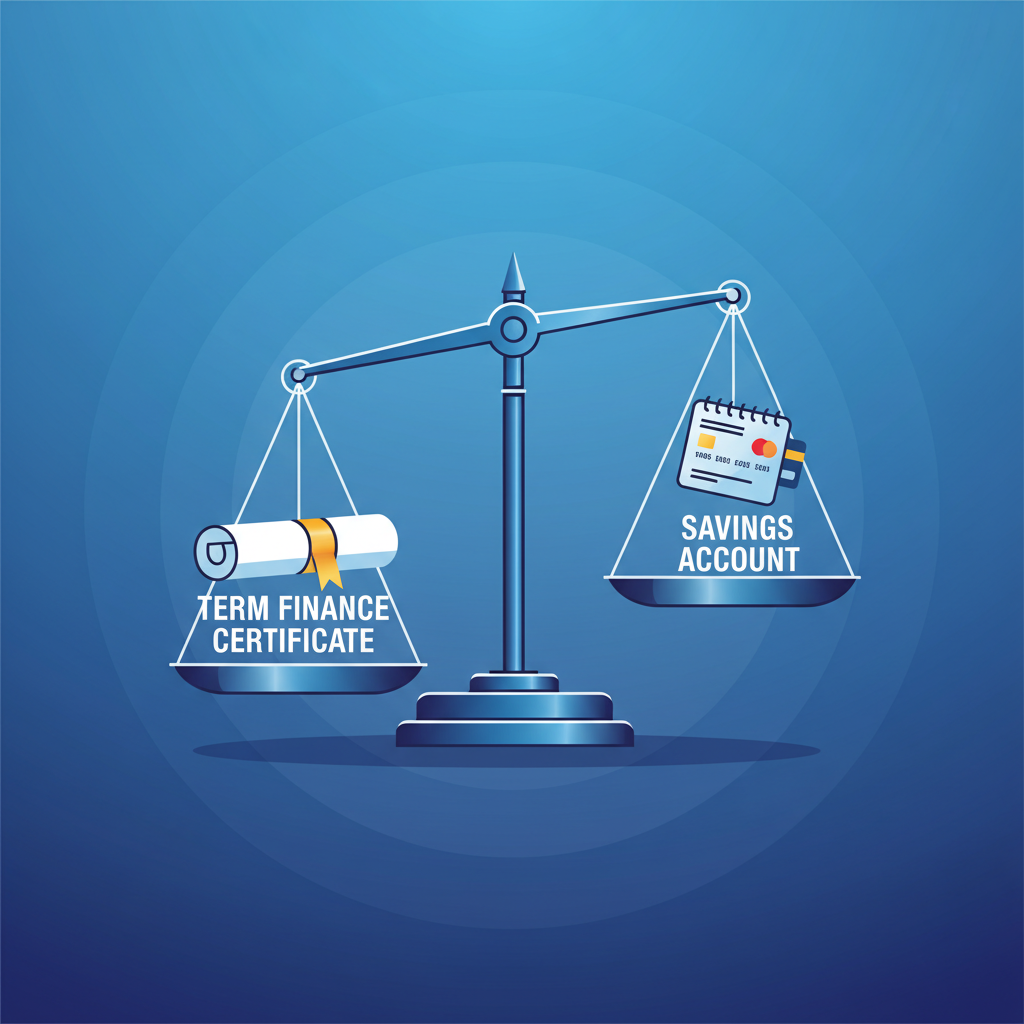
A term finance certificate (TFC) is a fixed-income financial instrument that represents a loan from investors to a corporate issuer. Understanding the term finance certificate meaning, how TFCs work, and their risks and rewards can help investors make informed decisions in the debt market. This article breaks down TFCs in clear, beginner-friendly terms.
Important Disclaimer
This article is for educational and informational purposes only. Term finance certificates and related financial instruments involve investment risk and are subject to market conditions, issuer credit quality, and regulatory factors. Nothing in this article constitutes financial, investment, or professional advice. Always consult a qualified financial advisor before making investment decisions.
Table of Contents
What is a Term Finance Certificate?
At its core, a term finance certificate is a debt instrument issued by companies to raise funds. Think of it like a loan you give to a corporation. Instead of borrowing from a bank, a company borrows money from investors like you. In return, they promise to pay you back your original amount (the principal) after a set period, plus profit (interest) along the way.
It’s called a “term” certificate because it lasts for a specific period—or term. This could be anywhere from a few years to a decade. Unlike buying shares in a company where your value goes up and down with the stock market daily, a TFC is more about stability. You generally know what you are getting into upfront.
While some people pursue a finance training certificate or a financial management certificate to understand complex derivatives, you don’t need a degree to understand TFCs. They are straightforward:
You buy the certificate.
The issuer pays you profit at regular intervals (like every six months).
At the end of the term, you get your money back.
These instruments are often used by companies when they need cash for big projects, like building a new factory or expanding into a new market. By investing, you are fueling their growth while securing a return for yourself.
Example
Suppose a corporation issues a term finance certificate with a face value of $1,000, a coupon rate of 6%, and a maturity of 5 years. If you buy one TFC, you would receive $60 per year in interest (6% of $1,000), typically paid semi-annually, and receive your $1,000 principal back at maturity (assuming no default).
Benefits of Term Finance Certificates
Why would someone choose a TFC over just leaving money in a bank account? The answer usually comes down to better returns and structure.
1. Higher Returns than Standard Savings Generally, companies have to offer better rates than banks to attract investors. If a savings account offers you 4% annually, a TFC might offer 8% or more. Over time, that difference adds up significantly.
2. Predictable Income Stream For bloggers and freelancers whose income fluctuates wildly from month to month, stability is gold. TFCs typically pay out profit semi-annually or annually. This creates a reliable income stream you can count on, regardless of how your blog traffic performed that month.
3. The Power of Compounding If you don’t need the cash immediately, you can reinvest your earnings. This triggers the magic of Compound Interest. By earning interest on your interest, your wealth grows exponentially rather than just linearly. It is one of the most powerful tools in building long-term wealth.
4. Diversification Putting all your eggs in one basket is risky. If all your money is in stocks, a market crash hurts. If all your money is in cash, inflation hurts. TFCs sit somewhere in the middle—offering better returns than cash but with less volatility than stocks. They add a layer of safety to your overall portfolio.
How to Invest in Term Finance Certificates
Investing in TFCs might sound like something reserved for Wall Street pros, but it is quite accessible. Here is a step-by-step guide to getting started.
Step 1: Research and Choose a Reliable Institution Not all TFCs are created equal. Since you are essentially lending money to a company, you need to trust that the company can pay you back. Look for companies with strong credit ratings. Agencies like Moody’s or S&P often rate these instruments. A higher rating (like ‘AA’ or ‘AAA’) means the investment is considered safer. Avoid issuers with poor financial health, no matter how high the promised interest rate looks.
Step 2: Understand the Terms and Conditions Read the fine print. You need to know:
Maturity Date: When do you get your principal back?
Profit Rate: Is it fixed or variable?
Call Options: Can the company pay you back early? (This might stop you from earning future interest).
Step 3: Determine Your Investment Amount Use a Savings Calculator to see how much disposable income you have available. Never invest money you might need for an emergency next week. TFCs are meant for the medium to long term. Once you know your budget, check the minimum investment requirement for the TFC you are eyeing. Some are accessible with small amounts, while others require larger buy-ins.
Step 4: Complete the Application Process You will likely need a brokerage account or a specific investment account with a bank to buy TFCs. The process usually involves filling out a form and verifying your identity (KYC procedures). If you already trade stocks, you might be able to buy TFCs through the same platform.
Step 5: Monitor Your Investment Once you’ve bought the certificate, your job isn’t entirely done. Keep an eye on the company’s performance. While TFCs are passive income, it’s wise to stay informed about the financial health of the borrower until your term ends.
Risks and Considerations
Term finance certificates carry risks including:
Credit risk: The issuer may default on interest or principal payments
Interest rate risk: Rising market rates may reduce the market value of existing TFCs
Liquidity risk: Selling before maturity may be difficult or require a discount
Understanding these risks helps investors weigh TFCs against other options.
Types of Term Finance Certificates
Just like there are different flavors of ice cream, there are different types of TFCs to suit different tastes and needs.
1. Fixed-Rate Term Finance Certificates These are the most straightforward. The company promises to pay you a specific percentage (e.g., 10%) every year until the term ends. This is great for planning because you know exactly how much money will hit your account and when. If market interest rates drop, you still keep your high rate. However, if market rates rise, your fixed rate might look less attractive.
2. Variable-Rate (Floating) Term Finance Certificates With these, the return isn’t set in stone. Instead, it is tied to a benchmark rate (like KIBOR or LIBOR) plus a margin. For example, the rate might be “Benchmark + 2%.” If the benchmark rate goes up, your payout increases. If it goes down, your payout decreases. These are good in environments where you expect interest rates to rise.
3. Shariah-Compliant Term Finance Certificates (Sukuk) For investors looking for ethical or religious compliance, Shariah-compliant certificates (often structured as Sukuk) are an alternative. These do not pay “interest” (which is prohibited in Islamic finance). Instead, they represent ownership in a tangible asset or project, and the returns are generated from the profits of that asset. It serves the same function as a standard TFC but adheres to Islamic principles.
Who Should Consider Term Finance Certificates?
Is a TFC right for you? It depends on your financial goals.
The Conservative Investor If the thought of the stock market crashing keeps you up at night, TFCs are a good middle ground. They offer better sleep-at-night factor than crypto or volatile stocks.
The Income Seeker Retirees or people who need regular cash flow love TFCs. The periodic payments can supplement a pension or salary.
Gig Economy Workers Freelancers often face “feast or famine” cycles. Finance for Gig Workers is tricky because income isn’t guaranteed. Parking surplus cash from a “feast” month into a TFC ensures that the money grows and isn’t spent impulsively, while providing a payout down the road when work might be slow.
Bloggers and Digital Entrepreneurs If you are running a blog, you might be saving up for a big expense—like a site redesign or hiring a writer—in two years. A TFC maturing in two years is a perfect place to store that cash so it beats inflation while you wait.
Risks and Limitations of Term Finance Certificates
No investment is entirely risk-free. Even though TFCs are generally safer than stocks, you need to be aware of the pitfalls.
1. Limited Liquidity Unlike a savings account where you can withdraw cash at an ATM instantly, TFCs lock your money away. While you can often sell your certificate to another investor on the secondary market, there is no guarantee you will find a buyer instantly or get the price you want. If you need cash urgently, selling early might mean taking a loss.
2. Interest Rate Fluctuations This is the risk that interest rates in the wider economy will change. If you lock in a fixed-rate TFC at 6%, and next year the banks start offering 8%, your certificate becomes less valuable. You are stuck earning less than the market rate.
3. Inflation Risk If inflation runs at 10% and your TFC pays 8%, you are technically losing purchasing power. Your money is growing, but the cost of living is growing faster.
4. Credit/Default Risk This is the big one. If the company issuing the TFC goes bankrupt, they might not be able to pay you back. This is why checking the credit rating is crucial.
Mitigating These Risks To handle these risks, you need a strong Financial Mindset. Don’t panic at the first sign of economic trouble. Diversify by holding TFCs from different industries. Don’t put all your money into long-term certificates; keep some in short-term options for liquidity.
Comparison: Term Finance Certificates vs. Other Investment Options
To truly understand the value of a TFC, let’s stack it up against the competition.
TFC vs Savings Accounts
Savings Account: High liquidity (withdraw anytime), very low risk, very low returns. Best for emergency funds.
TFC: Lower liquidity, moderate risk, higher returns. Best for growing wealth over 3-5 years.
TFC vs Mutual Funds
Mutual Funds: A pool of money managed by experts who buy stocks, bonds, or TFCs. Returns vary wildly. Equity funds can gain 20% or lose 20%.
TFC: You are buying a single debt instrument. Returns are more predictable.
Note: Many “Income” mutual funds actually invest in TFCs for you. Buying a TFC directly saves you the management fee the mutual fund charges, but requires you to do your own research.
While a finance certificate to get a job might help you analyze these differences professionally, as an individual investor, the choice comes down to your risk tolerance. TFCs sit comfortably in the “Moderate Risk, Moderate Reward” category.
TFC vs Bonds
Both TFCs and bonds are debt securities. However, TFCs are often issued in smaller denominations and may be more common in certain markets. Bonds may be issued by governments or corporates, while TFCs are typically corporate debt instruments with specific terms and covenants.
TFC vs Fixed Deposits (FDs)
Fixed deposits are bank products offering a declared interest rate and principal safety up to a limit. TFCs involve market risk and depend on issuer credit quality, which may offer higher yields but also higher risk compared to FDs.
Tips for Maximizing Returns on Term Finance Certificates
You don’t need a financial management certificate to optimize your TFC strategy. Here are practical ways to squeeze the most out of them.
1. Ladder Your Investments Instead of putting all your money into one 5-year TFC, split it up. Put some in a 1-year, some in a 3-year, and some in a 5-year TFC. This is called “laddering.” As each one matures, you get cash back to either spend or reinvest at potentially higher rates. It keeps your money somewhat liquid while still earning good returns.
2. Reinvest Your Profits Don’t spend the semi-annual interest checks on pizza. Reinvest them. Even if you can’t buy another full TFC, put that cash into a high-yield savings account or a mutual fund. This keeps the compound interest snowball rolling.
3. Plan with a Budget You can’t invest what you don’t have. Use a solidBudgeting Guide to identify “lazy money” in your monthly finances. If you can squeeze an extra $100 out of your budget monthly, accumulate it until you have enough to buy a TFC.
4. Watch the Economic Cycle If the central bank is raising interest rates, try to buy Variable Rate TFCs. If rates are at an all-time high and expected to drop, lock in a Fixed Rate TFC to enjoy that high payout for years to come.
Conclusion: Are Term Finance Certificates Right for You?
A term finance certificate can be a powerful tool for building stable, predictable wealth—especially if you prefer lower risk and steady returns over market volatility. For beginners, term finance certificates offer a clear structure: you know how much you invest, how long your money is locked in, and what returns to expect.
Whether you are a freelancer, blogger, gig worker, or conservative investor, adding a term finance certificate to your portfolio can help balance risk while protecting your savings from inflation. As with any investment, the key is choosing reputable issuers, understanding the terms, and aligning the certificate’s maturity with your financial goals.
If you’re looking for a simple, reliable way to grow your money without daily stress, term finance certificates are worth serious consideration.
Frequently Asked Questions
1. What is the minimum investment amount for a term finance certificate? It varies widely. Some TFCs aimed at retail investors might start as low as $500 or $1,000 equivalent. Others meant for high-net-worth individuals or institutions might require $50,000 or more. Always check the prospectus.
2. How is the profit calculated? Profit is calculated as a percentage of the face value (the amount you lent). If you have a $1,000 TFC with a 10% annual rate, you earn $100 per year. If it pays semi-annually, you get $50 every six months.
3. Are term finance certificates risk-free? No. They carry “credit risk” (the company could fail) and “interest rate risk.” However, they are generally safer than stocks because debt holders get paid before shareholders if a company goes bust.
4. Can I withdraw my money before the maturity date? Not directly from the company usually. To get cash out early, you typically have to sell the certificate to someone else on the stock exchange. The price you get will depend on current market demand.
5. What is the difference between a term finance certificate and a fixed deposit? A Fixed Deposit is with a bank; a TFC is usually with a company. FDs are generally safer but offer lower returns. TFCs are slightly riskier but pay more.
6. Are term finance certificates suitable for short-term goals? Generally, no. They are best for goals 1 to 5 years out. If you need money in 3 months, stick to a savings account.
7. How do I choose the best term finance certificate? Look at the Credit Rating (AAA is best), the Interest Rate (higher is better, but watch for risk), and the Tenure (does the timeline match your goals?).
8. Are there any tax implications for investing in term finance certificates? Yes. In most jurisdictions, the profit (interest) you earn from a term finance certificate is considered taxable income and may be subject to withholding taxes. Investors should understand the tax rules for interest income and consult a tax professional to ensure compliance.
9. Can I invest in term finance certificates online? Yes, most modern brokerage accounts allow you to buy and sell listed TFCs online, just like you would buy shares of Apple or Google.
10. What happens if the issuing institution defaults? If the company goes bankrupt, assets are liquidated to pay off debts. As a TFC holder, you are a creditor, so you are in line to get paid before stockholders, but there is still a chance you could lose some or all of your principal.
Sabir Abdirahman Mohamed is the founder of ThinkFixer and a personal finance and digital growth writer. He helps beginners learn how to save money, build online income streams, and grow blogs or businesses through practical SEO strategies. His content focuses on budgeting, smart money management, realistic ways to make money online, and step-by-step blogging guidance. His mission is to make financial and digital knowledge simple, actionable, and accessible for everyone.